FB100: #94 - Orpheus

This post is part of a project to watch the Film Bloggers’ 100 Favorite Non-English Films.

Orpheus screencap

Orpheus
France 1950; dir: Jean Cocteau
starring: Jean Marais, María Casares, Maria Déa, François Périer
screened 3/1/08, Criterion DVD

“The death of a poet requires a sacrifice to make him immortal.”

Unrelated to Orpheus, but a milestone nonetheless, this is the 500th post on this blog. Woohoo! Okay, back to the business at hand.

Previous Viewing Experience: Have never seen it before.

Knowledge Before Viewing: I know absolutely nothing about the story; but it forms a sort of trilogy with two other Cocteau films, Blood of a Poet and The Testament of Orpheus. I have actually seen Blood of a Poet, but a LONG time ago, and I mostly didn’t get it because it’s on the surrealist side. But I’m looking forward to Orpheus (despite the appearance of having put it off for, like two months), at least in part because Cocteau’s La belle et la bête is one of my all-time favorite films.

Brief Synopsis: Orpheus, a poet in post-war France, finds himself caught up with Death in the visage of a beautiful woman and her minions. When Death takes his wife Euridyce, Orpheus follows them into the underworld–but is it really Euridyce he desires, or is it Death herself?

Initial Viewing Response: Jean Cocteau was as much a poet as a filmmaker, and his films are poetic to their very core. The acting, writing, narration, music, visuals, and effects all come together to create a heightened mood — not realistic in any normal use of the word, but hyperreal. Or you could say surreal, I suppose, though Orpheus is much more closely aligned with the fairy-tale mood of La belle et la bête than the surrealism of Blood of a Poet. Although I should probably rewatch Blood of a Poet because I could be misremembering it horribly (in fact, I tend to get it mixed up in my head with Buñuel’s Un chien andalou, which may be a disservice to both of the films).

In any case, as you may have guessed, the story transplants and modifies the Greek Orpheus myth, in which the poet/musician spent so much time with his music that he ignored his wife, Euridyce. When she died, he went into the underworld to get her, and Hades allowed Euridyce to return to life with Orpheus on the condition that Orpheus could not look at her until they reached the world of the living. Impatient, Orpheus turned to look at her as they came near the exit of the underworld, and she was reclaimed by Hades. In Cocteau’s version (which may be another version of the myth, I’m not sure), the stipulation said that he could never look at her again, ever. And in any case, by that time, Orpheus was too infatuated with Death to be much interested in Eurydice at all. Another layer is added by the character of Herteubise, Death’s chauffeur and messenger, who falls in love with Eurydice while Orpheus is obsession over Death.

I won’t say I completely understand the film (did Death change her mind somewhere in the middle about what she wanted, or was the entire thing an elaborate plot on her part to balance Orpheus’s poetic obsessions with his domestic life?), but it was mesmerizing and beautiful to watch. And if you don’t know by now, I might as well say: I appreciate films more for the experience I have while watching them and the images they engrave on my consciousness than for pretty much anything else, and usually, the more ambiguous the point of the film, the more beautiful I find it. Cocteau’s special effects are simple and obvious, but they’re some how much more effective (and affective) than more elaborate, realistic effects would have been. Orpheus’s difficulty walking in the no-man’s land between the two worlds, the double-exposures revealing Death’s entry into this world and the glimpses of the other through mirrors, the filmed-backwards shots of Orpheus putting on the underworld gloves which suggest that time may not be working as we expect–all are clearly heightened, obvious effects, but they fit in perfectly with the poetic tone of the film.

There are a lot of things to think about; many quotes and ideas could be followed down philosophical rabbit trails, from the quote I used about about the immortality of a poet depending on a sacrifice (isn’t it in some ways true that poets must die before they can live forever–very few great artists are recognized as such during their life), to the connection of mirrors with death (Herteubise suggests that every time we look in a mirror, we see death). The problem with thinking TOO much about the film is that I’m not sure it makes logical sense, at least not in our normal definition of left-brained, linear logic. The motivations of Death and Orpheus aren’t aways clear (much less so than the more realist Herteubise and Euridyce, which is actually probably intentional now that I think of it), nor is the process for moving between the two worlds. Yet it somehow manages to make mystical sense, if you don’t try to impose propositional logic onto it.

Reflective Response: I think I’m going to ditch the reflective responses. A few days isn’t enough time to process these films, so the experiment in comparing immediate to reflective responses was flawed in theory.

Picspam

FB100: #95 - Run Lola Run

This post is part of a project to watch the Film Bloggers’ 100 Favorite Non-English Films. See my progress here.

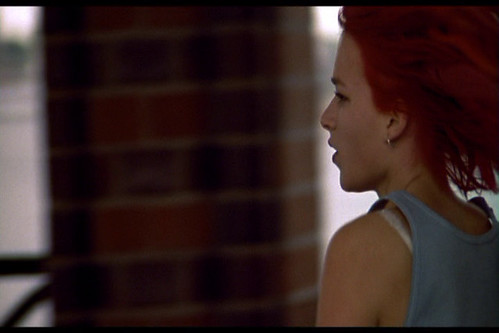
Run Lola Run (Lola Rennt)
Germany 1998; dir: Tom Tykwer
starring: Franka Potente, Moritz Bliebtreu
screened 1/28/08, DVD

“I wish I was a heartbeat that never comes to rest.”

Previous Viewing Experience: Oh, golly. This will be the fifth time I’ve seen this film. Guess you know I like it, eh? (Although I’ve seen Citizen Kane as many times, and I don’t particularly like it…)

Knowledge Before Viewing: This is one of my all-time favorite films, but I haven’t really written anything about it. So it’ll be interesting to see it with the intention of writing about it. The response will still likely be “OMG, I love this movie so much!!!!11!” Oh well. I honestly can’t remember what I’d heard about it before watching it the first time, or what my expectations were. But I’m sure they were exceeded.

Previous Reactions: I’ve never reviewed it before, but my rating on it is “Superior,” no question. It’s number 3 on my Best Films of 1999 list (it opened in the US in 1999, though it released in Germany in ‘98), and 1999 was a VERY good year for movies. Run Lola Run is one of two foreign films I use to bait people who say they don’t like foreign films (the other is Amelie, at #92 on this list). So far I’ve never shown it to anyone who didn’t love it; it taps into the MTV generation’s love of quick editing and techno-rock music (one of the best soundtracks to drive to, by the way), but also manages a surprising amount of depth in both story and narrative technique. I’m just glad to have an excuse to watch it again. :)

Brief Synopsis: Lola’s boyfriend Manni has lost a bag containing 100,000 marks which belongs to a local crime lord; she has twenty minutes to somehow get enough money to bail him out of the situation. Her attempt to get the money is repeated three times, with slight variations.

Response: Have I mentioned that I love this movie? Yeah, still do. On a philosophic level, it’s a fascinating inquiry into the nature of time, the efficacy of human action, and the mutability of fate. Each time through, there are slight differences: the first time, Lola might nearly run into a woman with a baby stroller, the second time, she does run into her. We’re shown in a rapid series of stills what happens to the woman afterwards: the first time, she loses her child to child services and steals another, the second she wins the lottery. There are several of these “and then” sequences for various people Lola encounters, and each one shows a different outcome. It’s tempting to imagine a cause-effect relation between Lola’s encounters with them and their futures, but I’m not sure that’s right; these are coincidental moments of little or no consequence–it could be a case of the butterfly effect (small actions have large consequences and the slight changes lead to radically different ends), but I think it’s simply that each person has a multitude of possible futures, and the film doesn’t necessarily comment on the degree of interrelation between chance and human action. It’s definitely a postmodern film, and the idea of multiple branching futures is found in a lot of postmodern narratives–compare it to certain sections of Italo Calvino’s Invisible Cities and If on a winter’s night a traveler, for example, or Jorge Luis Borges’s Labyrinths.


[This video is of the third time through the sequence]

The idea of multiple futures is backed up obviously by the tripartite structure, in which the first two attempts to save Manni fail, and Lola decides to try again–and does! The opening sequence, before we meet Manni and Lola, suggests that we’re playing a game which, like football (er, soccer), has established rules–the ball is round, the game lasts ninety minutes. Those are the constraints we’re given in the world we’re about to enter. But Lola doesn’t play by the established rules. And neither does this film, in all the best ways. Stylistically, Tykwer pulls every trick he can find: There are animated segments (which are just cool anyway, but also highlight the constructedness and artificiality of the story we’re watching), black and white sections, nearly frame-by-frame montages, long tracking shots, interspersed stills, jump cuts, handheld shots, split-screen (eat your heart out, 24), you name it. You’d think with all that he wouldn’t have time for much else, but there’s an entire subplot about Lola’s father and his mistress which surprises me every time with its depth, despite its sum total of probably four minutes on screen.

And there’s so much more I could probably talk about, but those are the main things that impress me every time. It’s just so enjoyable to watch, so well-structured as a narrative, and so fascinating as a philosophical exercise–and there are so few movies that manage to be all three, and in less than 90 minutes, too.

(Since I’ve seen this many times before, I opted not to include two responses; the response above can be considered a reflective response as well as an immediately-after-viewing response.)

Picspam!: Haven’t been able to do this on the last several, because I can’t screencap videos. Yay for DVDs! And movies I want to take the time to screencap.

FB100: #96 - The Exterminating Angel

This post is part of a project to watch the Film Bloggers’ 100 Favorite Non-English Films. See my progress here. Note: I have skipped #97 on the list, Satantango, because I have been unable to get it to watch and decided to move on. When I have the opportunity to see it, I will.

The Exterminating Angel

The Exterminating Angel
Mexico 1962; dir: Luis Buñuel
starring: Enrique Rambal, Lucy Gallardo, Claudio Brook
screened 1/9/08; VHS

“The best explanation of the film is that, from the standpoint of pure reason, there is no explanation.” - title card

Previous Viewing Experience: I have seen this once before, in June 2006.

Previous Reactions: The first time I saw this, I knew to expect something surreal and weird, because I’d already seen a couple of other Buñuel films; I got pretty much what I was expecting. While I found it a bit slow the first time through, I also found it compelling. I rated it Above Average then.

Brief Synopsis: A group of upperclass dinner guests find themselves unable to leave the drawing room after dinner, held there by an overwhelming apathy and inability to act. Meanwhile, the police and family members have gathered outside the house, unable to enter.

Response: I didn’t find it at all slow or repetitive this time. I was impressed by the strength of the plotting, especially since there’s really so little story to plot. It’s done with remarkable economy without sacrificing any depth, and the last sequence is the perfect cap off, bringing us full-circle and beyond. The film is a scathing attack on the privileged classes, really–a sort of counterpart to Buñuel’s later The Discreet Charm of the Bourgeoisie, except instead of a dinner party which can’t get started, The Exterminating Angel is about one that won’t end. I wasn’t as attuned to the surrealists’ hatred of the upperclass the first time I saw this, so I didn’t note with as much care the almost constant distinction being made between the upperclass guests and the servants, who all had an inexplicable desire to leave before the party started, and did so. Throughout the film, the guests make disparaging remarks about lower classes: “I think persons of the lower classes are less sensitive to pain. Have you ever seen a wounded bull? Absolutely numb.” Being confined in the drawing room for days and weeks, they experience what they imagine as the living conditions of the lower classes (though whether they realize the connection is unclear)–as the host of the party, one of the more level-headed in the group, puts it: “What I have hated since my youth, coarseness, violence, filth, are now our constant companions.”

It all becomes very Lord of the Flies-ish by the end, as they turn on each other. It’s much easier to blame someone else for unpleasant conditions rather than do something about it yourself. And this is, finally, their ultimately failure. They fail to act. They lack the willpower. And the most interesting thing is that they know they do! When Nobile, the host, says they need to work up a supreme amount of willpower and all leave the room together, rather than take his advice, they start blaming him for causing the whole problem by inviting them; eventually, they blame their absent families for not rescuing them. The other level-head, the doctor, at one point tells the now nearly barbaric guests that their behavior “is unworthy of us. Gentlemen, don’t forget your breeding.” But that’s the point. Their upperclass status isn’t going to help them in this situation, and it is in fact their apathetic, sophisticated, actionless aristocratic tendencies that threaten to destroy them.

(Since I’ve seen this before and remembered it pretty well, I opted not to include two responses; the response above can be considered a reflective response as well as an immediately-after-viewing response. I said my previous rating was Above Average; after this viewing, I re-evaulate that to Well Above Average. Give it a few more viewings, especially as I see more Bunuel films to add to the conversation, and it may quite easily move higher–especially if I can see a better print.)

FB100:#98 - The Gospel According to St. Matthew

This post is part of a project to watch the Film Bloggers’ 100 Favorite Non-English Films. See my progress here.

The Gospel According to St. Matthew

The Gospel According to St. Matthew
Italy 1964; dir: Pier Paolo Pasolini
starring: Enrique Irazoqui, Settimo Di Porto, Giacomo Morante
screened 12/30/07; VHS

Previous Viewing Experience: I have tried to watch this film, unsuccessfully. I think I made it through about the first five or ten minutes before I got really bored and quit. This was probably eight or ten years ago, though, when I was a teenager, so we’ll see if my attention span has improved.

Knowledge Before Viewing: My previous experience of trying to watch it has left me thinking it’s slow-moving and sort of…non-commital. The second thing fits with what I’ve heard about the film being a cinema verite, almost documentary-like version of Christ’s life.

Brief Synopsis: Exactly what you’d expect; the story of Jesus as told by Matthew’s gospel.

Initial Viewing Response: Right, so I’m perfectly willing to acclaim this as pretty much the most straight-forward, accurate version of Jesus’ life (perhaps excepting the Jesus movie, which is primarily used as an evangelical tool). But what catapults it into the realm of great cinema I haven’t yet figured out. My initial expectation of a non-commital storytelling style is spot-on, but I had thought it was supposed to be highly realistic and naturalistic; instead many of the scenes felt very staged and the actors were all very measured and stiff. I’ll need to read a bit about the production–that could be a side-effect of casting non-actors, who are sometimes paradoxically less naturalistic than trained actors (there are exceptions, like the girl Vittorio De Sica cast in Umberto D). Only the various scenes that have children in them (Palm Sunday, for example) have any sense of spontaneity and immediacy. This isn’t to say that there aren’t powerful scenes. Obviously the source material is powerful on its own, and that shows through in the Pharisee-conflict scenes and the slaughter of the innocents (which actually reminded me of Potemkin’s Odessa Steps sequence). I also found the use of English-language spirituals interesting, mixed in with more traditional church choir music. The idea of Jesus as an Italian peasant isn’t as strong as I expected it to be, though most of the costumes and buildings are believable as either Italy or Rome-occupied Israel. Basically, I’m trying to figure out what it is that I’m meant to get out of the film that I can’t get from reading the Bible, and I haven’t found anything yet. It’s a very literal adaptation, but where is Pasolini in it? (I haven’t seen any other Pasolini films, so I may be at a bit of a disadvantage there.)

Reflective Response: I was supposed to write this a few days after seeing the film, but it’s ended up being about three weeks. Ah well. After I wrote the initial response, I read the back of the video case, and it mentioned that the simplicity and directness of the film was in some ways at odds with the opulence of the Italian Roman Catholic Church, which I can definitely see. So what I may have missed in my initial viewing was the fact that presenting a peasant-class Jesus in a simple setting might have actually been quite radical when Pasolini made the film; it doesn’t seem that way to me, because that’s how I tend to think of Jesus anyway (perhaps as a Protestant, perhaps as a Biblical literalist). In any case, my initial reaction sounds as though I don’t find any value at all in literal adaptations, which isn’t entirely true–I just don’t think they’re as interesting, and while I might put a film like The Gospel According to St. Matthew on a list of great adaptations, I don’t know that I would put it on a list of great films. On the other hand, I’m fairly sure I’ve missed something.

FB100: #99 - Day of Wrath

This post is part of a project to watch the Film Bloggers’ 100 Favorite Non-English Films. See my progress here.

Day of Wrath cap

Day of Wrath
Denmark 1943; dir: Carl Theodor Dreyer
starring: Lisbeth Movin, Thorkild Roose, Preben Lerdorff Rye
screened: 12/18/07, VHS

Previous Viewing Experience: Never seen it.

Knowledge Before Viewing: Not too much, just that it’s a Dreyer film. I haven’t actually seen any Dreyer films, unless you count the few minutes of The Passion of Joan of Arc that Godard includes in Vivre sa vie. There’s some religious aspect to it, I think–inquisition or persecution or something.

Brief Synopsis: Anna, a young seventeenth-century woman married to a much older pastor charged with rooting out and interrogating witches, finds it difficult to escape being accused as a witch herself when she falls in love with her husband’s son.

Initial Viewing Response: I’m not sure what to write about this one, largely because I’m sort of ambivalent about it. The cinematography is pretty (and would have been prettier with a better print, I’m betting, if better prints exist any more), and the painterly framing is very evocative. Dreyer gets a good performance from Lisbeth Movin, especially, though her shift from sweet and innocent girl to someone you’d almost believe is a witch is a bit more abrupt than I would’ve liked. Yet you never really lose sympathy for her, even though she does rather blatantly cheat on her husband with his son–the accusation of witchcraft in the seventeenth century was basically a self-fulfilling prophecy, as proven by the “trial” and “confession” of an old woman near the beginning of the film (the woman curses the pastor and his family as she dies, which also complicates the motivations in the rest of the film). Apparently, the pastor married Anna when she was little more than a child without really getting her input on the arrangement (a plot point that probably would have been better revealed earlier than it was, by the way), and his mother hates her and refuses to give her any say in the household, so she’s never had the opportunity to make any decisions on her own. Not that I’m saying starting an affair with her husband’s grown son Martin was a good decision, but still. It’s a bit of a step from that to her being a witch–seemingly the default accusation for any woman who doesn’t behave precisely as the men around her want and expect.

Given that Dreyer made this film in 1943 in Denmark, I was expecting the Inquisition to be more overtly Nazi-like. They sort of were at the beginning, when trying to force the old woman to name names and take other “witches” down with her, but as the story shifted more and more over to Anna, I didn’t see it as much. Still, I think there was enough similarity to get Dreyer in big trouble, forcing him to leave the country.

Reflective Response: A week later now; I’m still ambivalent. The fact that the old woman who was burned at the stake at the beginning cursed the pastor and Anna bothers me. It almost suggests that the old woman was a witch, and though that doesn’t make the torturous interrogation techniques she was subjected to any less horrific, her vindictive attitude does waver my sympathy for her a little bit. Similarly, Anna is very sweet and demure at the beginning and becomes almost dislikable near the end. (The very end, when she realizes that there’s really nothing she can do to avoid accusation, regains any sympathy she may have lost.) It’s tempting to apply feminist criticism to the film, which would read Anna as oppressed at the beginning, subjugated into passivity by a patriarchal system; as she moves into self-affirmation and asserts her own will, she naturally appears less “sweet,” because she’s rebelling against the norms that value “sweet” women and attempting to become a strong woman instead, a move which results in an accusation of witchcraft by the patriarchal establishment. That reading makes a lot of sense, though trying to work the film’s religious background into a feminist reading makes my brain hurt.

I often judge a film’s greatness based on how well it sticks with me–how much I can’t stop thinking about it after I’ve watched it. I haven’t really thought about Day of Wrath at all since I watched it (until I sat down to write this). The only scenes that have really stayed with me are the interrogation scene of the old woman and Anna’s realization that she’s trapped by her mother-in-law’s accusation. The first is understated and yet horrible, while the second is tremendously well-played, showing up in minute shifts in the actress’s expression. Oh, wait, I forgot. One of the most beautiful and virtuosic shots follows Anna as she crosses a large, columned room to overhear the judgment on the old woman. It combines the high-contrast cinematography that Dreyer inherited from German Expressionism (and would soon be a key feature of film noir) and the deep focus photography from contemporary films like Citizen Kane.

FBTop 100: #100 - The Cranes are Flying

This post is part of a project to watch the Film Bloggers’ 100 Favorite Non-English Films. See my progress here.

The Cranes are Flying

The Cranes are Flying
USSR 1957; dir: Mikhail Kalatozov
starring: Tatyana Samojlova, Aleksey Batalov

screened 11/13/07, Criterion Collection DVD

Previous Viewing Experience: Never seen it before.

Knowledge Before Viewing: I know it’s a Soviet film, and not much more. I’m pretty sure there’s a central romance, and possibly something war-related. I purposely didn’t read anything about it, even the Netflix envelope. I feel like a Soviet film would be depressing, or dark, or overly restricted, but that’s a preconception of Soviet cinema and not this film specifically. A preconception which is likely unfounded, because my knowledge of Soviet cinema is pretty much…Eisenstein. For some reason I also have a sense (though I have no idea from where) that this film isn’t going to be depressing. Possibly it’s because the image of cranes flying seems uplifting. Okay, I keep being tempted to add to this section as I’m watching the first few minutes, and that’s bad. STOP. NO MORE WRITING.

Synopsis: Young lovers Boris and Veronika are separated when he volunteers for the war. Never hearing from him, she marries his cousin, who has an exemption from the draft. Later, she realizes her mistake and continues to hope against hope (and reports from the front) that Boris remains alive and will return to her when the war ends.

Initial Viewing Response: Well, it’s definitely sad. Sadder than I expected, but I still agree with my preconception that it’s not depressing. The thing I’m mostly coming away with is a great pleasure in the painterly aspects of the film. The mise-en-scene is really powerful, if a little more posed than what we’d consider realistic today. In fact, there are a lot of things that aren’t realistic in style at all, and aren’t meant to be. The cousin, Mark, seduces (not a violent enough word) Veronika in a scene which is very nearly expressionistic, during an air raid with Tchaikovsky banging in the background and the wind whipping through the blown-out windows. In a Russian film, this doesn’t really seem unnatural (hello, country of Dostoevsky, who I love BTW), but the scene would be hopelessly overwrought in many other contexts. Another part uses bizarre camera angles and highly disorienting editing (persistence of vision is destroyed first by the slats in a fence, then by unmatching sequential frames) to depict Veronika’s near-suicidal mindset at one point; that sequence is nearly avant-garde, though the rest of the film isn’t terribly (it’s the first minute and a half or so of this clip). The use of montage to create visceral responses in the viewer is a very Russian technique, pioneered by Eisenstein and others in the 1920s. The flip side, though–the use of very careful and painterly mise-en-scene–I tend to associate more with Germany. It’s very interesting to see both of them together in the same film, and both so effectively.

Found the air raid scene on YouTube. I *heart* YouTube. It’s subtitled Spanish, but basically, they hear the air raid sirens, Mark tries to get Veronika to go to the subway (the impromptu air raid shelter), but she refuses because her parents were killed in the last air raid, and she hasn’t quite gotten over it to the point where she’s concerned about her own safety. So Mark stays with her and plays really loudly to try to drown out the noise; after he grabs her in the corner he tells her he loves her, and she cries “no” and hits him a lot. This style of highly theatrical acting is not really found anywhere else in the film, suggesting that it’s very intentional. I haven’t decided yet whether the scene works on that level, but on the level of photography and lighting, I think it’s gorgeous.

Picspam! (I don’t know if I’ll do this all the time; probably depends on how pretty I think the movie is, and how tired I am after watching it)

Reflective Response: Looking back over what I wrote three days ago under initial reactions, I realize that I didn’t talk about the plot hardly at all, which is based in two tendencies I have in general about film. First, I don’t want to spoil anyone who hasn’t seen it yet and might (note: I do spoil a bit of the end in the next two paragraphs–it’s really hard not to when trying to move into criticism instead of just reviewing). I greatly enjoyed watching The Cranes are Flying without knowing anything about it. Second, I’m starting to believe that plot is sort of secondary. I don’t mean that the plot is unimportant, simply that “what is the story” is a less helpful question than “how is the story told.” I’m very interested in narrative and narrative structure, but that’s a bit different than just the events. I was about to invoke David Bordwell and Kristin Thompson’s distinctions regarding story and plot, but I’ve already mangled the two by using them interchangeably, and I don’t have a copy of Film Art lying around to remind myself of the specifics. Let’s just leave it that what happens in a film is a less compelling value criterion than how it happens. (Same thing is true of books.)

I initially thought some of the motivations in The Cranes are Flying were underdeveloped, specifically Veronika’s decision to marry Mark instead of wait for Boris. But I think it’s more that the narrative underplays the motivations. They are there, but they’re subtle. Mark’s attraction to Veronika is set up very early, but in a light-hearted, playful way that contrasts with his almost menacing advances during the air raid. Is this a character shift? Maybe, because the air raid scene is so very stylized and exaggerated that character is almost subsumed into atmosphere. Yet, on the other hand, the very stylistic differences emphasize the huge shift between two carefree characters who haven’t even considered the possibility of war and two characters whose families have been torn apart and destroyed by a war which invades their very living rooms. Veronika seems to give up on Boris for a while, but the script accounts for that as well–she never receives a single letter from him. It’s not clear if he’s not writing or if the mail isn’t getting through, but the couple of scenes where she hopes to hear from him and doesn’t show her wavering in her belief that he’s still alive or that he still loves her, opening the door for her to succumb to Mark’s advances when they come. Her point of view switches later, when she almost blindly expects to see Boris after the war ends, even though she’s been told that he is dead. Blind disbelief switches to blind belief, though the film ends on a bittersweet note of hope within pain.

It would be easy to criticize the wide range of stylistic devices used in the film as uneven and jarring, but the tension between realism and expressivism is, I think, very important to the visceral difference between war and peace. It isn’t always as balanced as it could be, but it is largely effective. Tatyana Samojlova holds the film together as Veronika, growing from the silly young girl of the beginning into the bitter, unhappily married nurse in the middle, and finally into a strong, centered woman who is able to grieve herself and also join in the joyful celebration of those around her. While watching the final scene, I was struck by how different this woman is from the near-child she was in the first few scenes, and yet the continuity of character was never lost. Her performance alone is worth seeing the film.

New Project: Watching the Film Blogger’s 100

I wanted to catch up on the recap posts before I started this new film-watching project. I don’t really know why, because they’re mostly unrelated. But ah well. Goals don’t have to have extrinsic meaning to be useful. Anyway, now I have caught up, so here’s my project. A few months ago, I linked to a list of 100 favorite non-English language films chosen by lots of film bloggers, coordinated by Edward Copeland. Now, this list isn’t definitive, and several people in the comments have mentioned films that do seem to me like they should’ve been on it. Still, I’ve only seen about half of the films on the list, so I figure it’s as good a place to start giving some direction to my viewing as anywhere else.

So I’m going to watch it. All of it. Even the ones I’ve seen before, because these are the sort of films that richly reward rewatching (try saying that three times fast–without sounding like you haven’t learned to pronounce your “r”s yet), and several of them I saw when I probably lacked the maturity and cinematic knowledge to really get them. Then I’m going to post a review of each one, telling my preconceptions, my original reaction if I’ve seen it before, initial post-watching thoughts, and then my thoughts after a few days of thinking about it. There are multiple reasons for this way of going about it; I want to see how my reactions have changed over the years on films I’ve seen before, I want to see the differences between gut reactions and reflective ones (although a few days may not be long enough), and I want to see how preconceptions play into my reactions. These are things that are always in my mind when I watch and write about film, but I want to make them explicit. For the recaps, my usual procedure is to write a sentence or two right after I see a movie, then refer back to that when I write the recap; sometimes, depending on how long the entire recap takes to write, I go through three or four mental drafts, sometimes drastically changing my entire evaluation of the film–but the final recap is an amalgamation. I want to see what it looks like if I keep the drafts separate. This is as much a writing exercise for me–encouraged by the rhetoric and composition class I’m taking right now, no doubt–as anything else, but maybe someone else will find the process interesting as well.

The biggest question is, can I keep it up for 100 films, which will likely take me multiple years to get through? My previous track record with projects like this would suggest no, but hey. Best way to fail is to never start, right? I’ll keep a list of films and review links here.

Since I’m going in reverse order, the first film up is The Cranes are Flying, which I’ve had from Netflix for like three weeks, waiting until I was ready to embark. I watched it last night, so I’ll probably finish up the post about it tomorrow. The only exceptions to the list order will be when reverse-watching the list places series films out of order (I’ll decide how to do those when I get to them–if I’ve already seen them, I may stick with list order rather than film order) or if the film isn’t easily obtained; several of the films on the list are out of print or have never been released on DVD. I’ll try to get them, but there are sure to be some that I can’t.

(Filmbo/Eric, I know you mentioned you didn’t agree with a lot of the list; do you disagree with what’s included or the order? Or both? I’m just curious.)