Month: November 2008 Page 1 of 2

Netflix Recommendations, or How I Apparently Ruin the Queue Curve

The million dollar prize for improving Netflix’s recommendation system (Cinematch) by 10% has been out there for a couple of years now, and programmers are now within a few tenths of a percent of getting there. The New York Times has a new article about it here. Not a lot of new information over the various articles that have come out since the prize was announced, but I’m still stymied by how weird I am, apparently, in the movie rental world.

Cinematch has, in fact, become a video-store roboclerk: its suggestions now drive a surprising 60 percent of Netflix’s rentals. It also often steers a customer’s attention away from big-grossing hits toward smaller, independent movies. Traditional video stores depend on hits; just-out-of-the-theaters blockbusters account for 80 percent of what they rent. At Netflix, by contrast, 70 percent of what it sends out is from the backlist — older movies or small, independent ones. A good recommendation system, in other words, does not merely help people find new stuff. As Netflix has discovered, it also spurs them to consume more stuff.

For Netflix, this is doubly important. Customers pay a flat monthly rate, generally $16.99 (although cheaper plans are available), to check out as many movies as they want. The problem with this business model is that new members often have a couple of dozen movies in mind that they want to see, but after that they’re not sure what to check out next, and their requests slow. And a customer paying $17 a month for only one movie every month or two is at risk of canceling his subscription; the plan makes financial sense, from a user’s point of view, only if you rent a lot of movies.

Okay, first off, I do want to know how they’re deriving the fact that Cinematch is responsible for 60% of Netflix’s rentals. Are they going off how many people rent movies from the recommendation page or from the “movies like this” thing that pops up when you add a movie to your queue? Because if so, the number’s suspect. To me, saying a recommendation system is responsible for a rental means that the person would not have rented it without the recommendation. But I add things ALL THE TIME from the pop up thing not because I didn’t know about the film or that I wanted to rent it but because it’s convenient and saves me from having to search for it. But that’s a bit by the by.

“New members often have a couple of dozen movies in mind that they want to see, but after that they’re not sure what to check out next.” Wow. I can’t even imagine that. I have somewhere around 1450 films spread across three Netflix queues (you can only have 500 per queue), and that’s not including the 400+ discs worth of TV shows that I have in yet another queue. (It does, however, include several instant watch movies that I’ve seen before and probably wouldn’t rent if they weren’t streaming for free.) A couple of dozen? I’m sorry, I can’t wrap my head around that. There are probably 24 films in theatrical release RIGHT NOW I’d see. Much less the last 100 years of cinematic history. Clearly I am strange.

There’s also an interesting bit earlier in the article about how much Napoleon Dynamite; and other love-them-or-hate-them films like Lost in Translation; and I Heart Huckabees; throw off the system, because it’s so difficult to predict whether someone will like them or not. I can totally see that, and all the films they mentioned are ones that I tend to avoid recommending most of the time, for the same reason. Except Lost in Translation, because I have mad, blind love for Sofia Coppola.

The good thing about all this is, I think, the fact that the recommendations are apparently encouraging people to check out more offbeat, older, and independent films. That’s a great thing about a subscription service with so wide a selection – the cost of experimentation is very low. I often think this should be a critic’s job, too – rather than warn people away from the latest multiplex blockbuster that they’re going to see anyway, turn them on to a hidden gem they might otherwise miss amidst the flurry of big studio publicity. (I think Netflix should put up pages for all the major festivals, since that’s where the best indies first come to light. It would certainly save me a lot of time and effort currently spent in searching Netflix for every festival film every few months in case it suddenly ended up with a distribution deal. /selfish)

So tell me, do you use Netflix’s recommendations? Or if you’re not a Netflix subscriber, some other sort of algorithmic recommenations, like Flixster? Does it influence 60% of your rentals? Does anyone rely  on recommendations of this sort, rather than also factoring in human recommendations, whether from friends, critics, or bloggers – or a personal affinity for a cast or crew member? In other words, if Netflix recommended a movie (with a higher than 4.5 predicted star rating, let’s say) you hadn’t heard of, and you didn’t know any of the actors or the director, would you rent it without digging up more info? I wouldn’t. But as already decided, I am strange. And maybe I would get to that unknown film, once I got done with the 1400 already in my queue. :)

Ooh, just got to the end of the article (yes, I’m reading and writing at the same time – sue me), and found this: “[Netflix CEO Reed] Hastings is even considering hiring cinephiles to watch all 100,000 movies in the Netflix library and write up, by hand, pages of adjectives describing each movie, a cloud of tags that would offer a subjective view of what makes films similar or dissimilar. It might imbue Cinematch with more unpredictable, humanlike intelligence.” I WANT THAT JOB. When that job is posted, Mr. Hastings, let me know, mmkay?
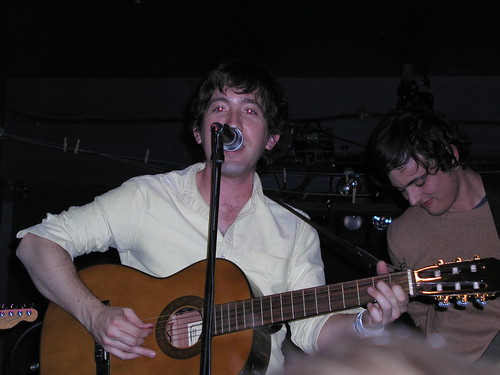
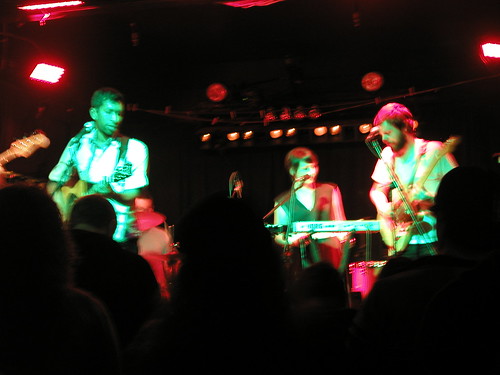
Bishop Allen @ The Echo, 11/11/08

Guess who finally remembered to take her camera to a concert and thus can use her own pictures instead of scrounging ones from Flickr? Yay! On the other hand, I’m still working on finding the best camera settings for low light conditions, so… Still. MINE.

007 - Bishop Allen @Echo, Los Angeles, 11/11/08

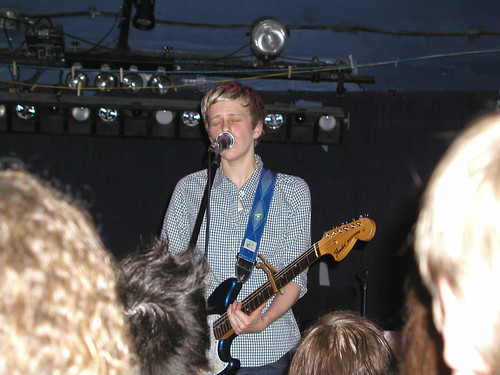
Before Bishop Allen, though, were three opening bands, all of which I enjoyed. First up was The One AM Radio, who actually started before I got in (whole ticket fiasco which was not as much of an issue as I thought it was going to be, but caused me to be in the wrong line – won’t get into it). I was in line with a bunch of people who knew the keyboardist/backup singer, so that was cool. For a little while I felt almost part of the Silverlake scene. Speaking of the Silverlake/Echo Park music scene, the Echo is a great venue. It’s the perfect size, with a good bar (and food, apparently, though I didn’t eat there) and a really great vibe. The bands were wandering around before, during, and after the show, so it felt really casual and intimate. Okay, back to the show. I’d actually heard of The One AM Radio before; they have a track on the compilation CD “Give. Listen. Help.” (available from Urban Outfitters; almost all of the proceeds go to children’s cancer research), which I really enjoyed. Their newest album (from 2007) is called This Too Will Pass, available from Amazon CD and MP3. I apologize for the blurryness of the photo. First one I took, and I was still testing flash vs. no-flash. (Flash is better, FYI.)

001 - The One AM Radio @Echo, Los Angeles, 11/11/08

The One AM Radio – Old Men

Then came The Electric Owls, which turned out to be one guy – but I think there are sometimes more of them in the band? I wasn’t really clear on that. Anyway, he could pick a mean guitar, and he sorta reminded me a little bit of Glen Hansard, except not Irish. I didn’t have a good angle from where I was at the time, so no pictures of him.

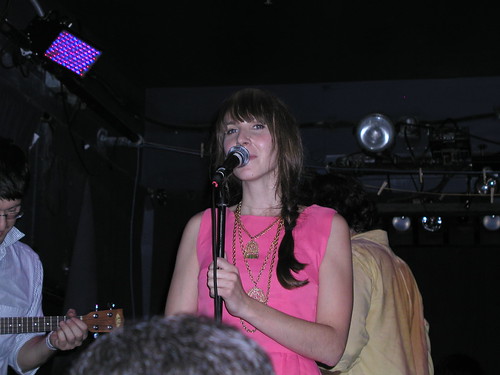
And I REALLY liked the third opening band, An Horse. Not only because they’re from Australia, though I admit that’s part of it. Kate Cooper, the singer/guitarist, was adorable and funny. She bantered more between songs than most. “We’re from Australia, which I’ve just been told is right next to Switzerland. It isn’t really. It’s actually a whole other planet in the solar system.” The other band member, Damon Cox, played the drums and sang backup. Sort of a Mates of State sort of thing, except with guitar instead of keyboards. I wanted to pick up a CD or something of theirs, but didn’t see any on the merch table as I went out. I must’ve missed them. Their album Not Really Scared is available on iTunes, or as an import from Amazon, but that’s way more expensive.

003 - An Horse @Echo, Los Angeles, 11/11/08

An Horse – Scared as F**k (sorry for the title, but it is the best song, and the one containing the album’s title)

Then Bishop Allen! I will say that I finally know how annoying it was for fans of The Shins when Garden State came out and suddenly there were a lot more Shins fans based solely on their inclusion in the film. Not that I object to bands gaining more fans, and in fact, I’ll admit I’m a Garden State Shins fan. But now I feel an irrational, overly defensive need to declare that I was a Bishop Allen fan long before they were featured in Nick and Norah’s Infinite Playlist, and in fact, went to see the film in no small part because of Bishop Allen’s involvement. There, done being defensive. Sorry about that.

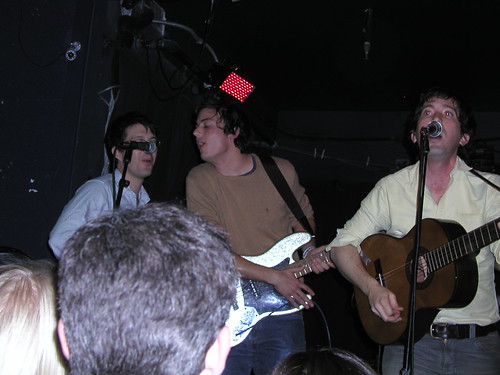
Anyway. They had an issue with Darbie’s mic, so after futzing with it for a while, they finally had to make do with one less mic than usual, which meant that bassist Keith kept having to run over to guitarist Christian’s mic whenever he was needed for backup vocals. :) In his tour blog, he complained about tripping over cables, but assuming he wasn’t actually hurt, it ended up being rather more amusing than not.

005 - Bishop Allen @Echo, Los Angeles, 11/11/08

They did a great mix of songs from The Broken String and the various EPs they’ve put out – last year, they tested the limits of prolificness by putting out an EP every month. And succeeded. I should’ve picked up some of those, but being faced by all 12 EPs on the merch table was a little overwhelming. And did a couple of new songs from the album they’re working on now. Yay new stuff! After the briefest pre-encore break ever, they finished it all up with the Darbie-led “Butterfly Nets” (which was the first song that made me a fan). And it was good. And then I mostly copped out of a review by mostly posting photos.

015 - Bishop Allen @Echo, Los Angeles, 11/11/08

Bishop Allen – The Same Fire (from “June EP”)
Bishop Allen – The Monitor (from “The Broken String”)
Bishop Allen – Butterfly Nets (from “The Broken String”)

Amazon.com CD
Amazon.com MP3
EPs at Bishop Allen.com
Amazon.com MP3
EPs at Bishop Allen.com
Amazon.com MP3

(Amazon.com MP3 has all the tracks from the EP Project available in two sets, but they were originally released as twelve 4-song EP CDs. Check out the Bishop Allen store page to see the original covers, designed by Darbie.)

Blogging is Life-Changing

Anna of Goannatree tagged me for a meme (originally started at Seedlings in Stone) wondering how blogging has changed your life, for better or worse. Let’s see what I can come up with.

1. Blogging has helped me find who I am as a writer. I’m not wholly there yet, in the writer-finding process, but I’m definitely closer than I used to be. I’ve always written well (at least, judging by my grades), but writing for class always carries some amount of artificial restrictions. I was always a more personal writer than I probably should’ve been in academic contexts, but in grad school, writing for class and writing a blog at the same time really helped me to pick out which parts of my writing came from academic requirements and which ones were me, and how to use both to my advantage. And also figure out that I’m a much better fit as a blogger than as an academic writer.

2. Blogging has given me an online community. Blogging is very fluid and bloggers in general tend to be very open, and you can enter communities without too much difficulty, if you try. I’m still on the outskirts of the film blogging community, but that’s because I haven’t tried hard enough yet (and I don’t want to completely alienate the people who read because they know me personally – more on that in #5). But blogging is also an easy entrance into other social media options – I have a really enjoyable cadre of friends on FriendFeed right now that’s largely independent of this blog, but I wouldn’t be there if I hadn’t been a blogger first.

3. Blogging has helped me shape not only my identity as a writer but as a person. It’s a cliche that you can be whoever you want to be on the internet – I’m not sure it’s 100% true, because it’s very hard to be someone completely different than you consistently. On the other hand, it’s not difficult to shape and mold your identity a little bit online, and as you learn to do it in safe anonymity and distance online, you learn to become a little bit more like the person you want to be offline as well. I can definitely state that I’m a different, less shy (except with phones, that’s a different thing), less fearful person than I was before I started blogging/interacting with people online.

4. Blogging has given me a different perspective on online life. Sort of what Anna mentioned about learning to value internet surfing more since she started blogging. I’ve been a participant in message boards and journals for years, long before I started this blog, but after seeing the things that the tech sector and the political sector and the film sector and, well, everywhere really, is doing with blogs – using them in innovative ways from the very individual to the very journalistic to the very academic – I’ve learned again and again that to claim that bloggers are just a bunch of navel-gazers focused on minutiae is to miss the wide variety, interests, and quality of the blogging world. If you think that about bloggers in general, you’re reading the wrong ones.

5. Blogging has made me very aware of audience. Writing for school, the teacher is the audience, no matter how much they try to make the assignment call for a different audience (unless you have a fairly radical composition teacher, which I never had). In blogging, you have to constantly remember at least three audiences: the one you know you have (from people who comment or tell you in person they read your blog), the one you want to have, and the completely amorphous one made up of everyone anywhere who may stumble upon your blog from a link or a Google search. For me, the first one is a few people from my church, a few people from school, internet friends from previous boards, and people I know on FriendFeed or in the film blogosphere. That’s a wide range of people already I have to think about as I wonder how everything I say will come across. The one I want to have is the film and entertainment blogosphere (I would say film only, but I’m having increasing trouble keeping music out of the spotlight), so I think about trying to post things that would interest them. The amorphous one you can’t really plan for (though you can follow it somewhat through stats trackers), but you have to be aware that everything you say is public. Lately, potential employers have been greatly on my mind in this category, since my blog is my major writing sample when I apply to writing/editing/proofreading jobs.

That last thing has actually been on my mind for a while, as my blog has gone through some focus and identity changes in the past few months, so it’s good to get that out there. Thanks, Anna!

Let’s see, I’m horrible about tagging people, but saying “I tag everyone!” is a cop-out. So I’ll tag:
Abby – Pretty Funny for a Girl
Kat – So. There’s That.
Lori – She’s No Lady
Evan/Luke – MovieZeal
Ed – Only the Cinema

And anyone else, of course.

Here are the rules:

1. Write about 5 specific ways blogging has affected you, either positively or negatively.

2. Link back to the person who tagged you.

3. Link back to this parent post on Seedlings in Stone.

4. Tag a few friends or five, or none at all.

5. Post these rules— or just have fun breaking them.

Film Classics – Sunrise: A Song of Two Humans

Sunrise: A Song of Two Humans

directed by F.W. Murnau
starring George O’Brien, Janet Gaynor, Margaret Livingston
USA 1927; screened 8 July 2008 at the Silent Movie Theatre, Los Angeles

Let me just quickly tell you about me and Sunrise: A Song of Two Humans. It’s been on my see-soon list for years, as one of the most highly regarded silent films ever. Initially I added it to my Netflix queue, knowing it had been released on DVD as part of a Fox box set though not individually. Netflix apparently lost their copy or something and decided not to replace it, putting in the “unavailable” section of my queue instead. Plan B: Wait for it to come on during TCM’s Silent Sunday Nights or 31 Days of Oscar program. Several months later, it did, and I smiled and set my DVR. Which decided to flake and tape only the first five minutes. Foiled again. About a year later, I moved to LA and what should be showing at the local repertory cinema? Yep, Sunrise accompanied by a live band with an original score. And it was one of the best cinematic experiences of my life, so apparently the cinema powers-that-be just knew that I needed to wait and see it in a cinema rather than on DVD or TV. Thank you.

I’ve heard over and over that silent film had reached a heady apex of artistry by the 1920s that was shattered by the coming of sound and its attendant clunky equipment, but I’m not sure I ever fully believed in the poetic power of silent film as a fully realized art form until I saw Sunrise. I’d been impressed by individual elements of several silent films – the physical comedy of Buster Keaton, the pathos of Charlie Chaplin, the Expressionist oddness of The Cabinet of Dr. Caligari - but never had I seen a film that combines the traditional qualities of silent film with a such a timeless sense of humanity and beauty.

The story is simple. A husband ignores his sweet but inconsequential wife in favor of a femme fatale (or vamp, since we’re in the 1920s) from the big city. The vamp convinces the husband to kill the wife to get her out of the way, but as he’s about to do this, he can’t and instead takes the wife to the city and they reconstitute their love. The very simplicity of the story, however, is what allows director F.W. Murnau room to exercise his Expressionist-influenced visual flair and create a dark, moody landscape for the characters to inhabit.

Near the beginning, the vamp coyly leads the husband through the wet and disorienting marshes near his farm, a scene ripe for interpretation by Freudian critics, let me just say. Similarly, the near-murder scene is overacted by both the husband and the wife, but Murnau uses the overdetermined silent movie acting style to great psychological advantage – out of context, the scene could easily be laughable today, but no one in the cinema was laughing. Later, the city is a bustling, dangerous place, showcasing the physicality and motion that silent films perfected before sound came and changed the game.

Though I’m far from seeing all the silent films available (which is still only a small percentage of the ones that were made), I feel fairly confident in declaring that Sunrise represents the epitome of silent film art. It’s not for nothing that it won “Outstanding Artistic Achievement” at the first ever Academy Awards – an award that was never given again. If you can see it in a cinema, do. Otherwise, keep your eye on TCM, as they do play it occasionally.

Favorite Films, One Letter at a Time

I rarely organize my collections alphabetically, at least not as the major organizational tool, since the letter the title starts with is usually less meaningful than the year it was made or the genre that it’s in. But there’s a meme going around film blogs (starting with Blog Cabins) to choose one favorite film that starts with each letter of the alphabet. Forcing you to pick something from each letter is generating some interesting results, so I thought I’d give it a try. (Other entries I’ve seen include: Only the Cinema, Film Doctor, The House Next Door, and Spoutblog.)

Shameless self-promotion – this task was made a lot easier since I recently completed a full list of all the films I’ve ever seen over at my archive site. Still working on the ancillary lists organized by year and rating, but the by title one is done.

AThe Adventures of Robin Hood (1938; Michael Curtiz & William Keighley)
BBand of Outsiders (1964; Jean-Luc Godard)
CCity of Lost Children (1995; Jean-Pierre Jeunet)
DThe Double Life of Veronique (1993; Krzysztof Kieslowski)
EElection (1999; Alexander Payne)
FThe Fountain (2006; Darren Aronofsky)
GGentlemen Prefer Blondes (1953; Howard Hawks)
HA Hard Day’s Night (1964; Richard Lester)
IIn a Lonely Place (1951; Nicholas Ray)
JJFK (1991; Oliver Stone)
KKey Largo (1948; John Huston)
LLock, Stock, and Two Smoking Barrels (1998; Guy Ritchie)
MMulholland Drive (2001; David Lynch)
NThe Naked Kiss (1964; Samuel Fuller)
OO Brother Where Art Thou (2000; Joel & Ethan Coen)
PPersona (1966; Ingmar Bergman)
QThe Quiet Man (1952; John Ford)
RRear Window (1954; Alfred Hitchcock)
SSunrise: A Song of Two Humans (1927; F.W. Murnau)
TThe Thin Man (1934; W.S. Van Dyke)
UThe Umbrellas of Cherbourg (1964; Jacques Demy)
VVertigo (1958; Alfred Hitchcock)
WThe Women (1939; George Cukor)
XX-Men (2000; Bryan Singer)
YYoung Frankenstein (1974; Mel Brooks)
ZZodiac (2007; David Fincher)

Anyone else reading this, please feel free to post your own. Consider yourself tagged.

Page 1 of 2

Powered by WordPress & Theme by Anders Norén